Handrail
Stainless or aluminium, wall-mounted or on glass — the line you hold for thirty years.
Made to measure — priced after survey
The product
The line you hold for thirty years
It is the only part of a balustrade the user judges by hand, every day.
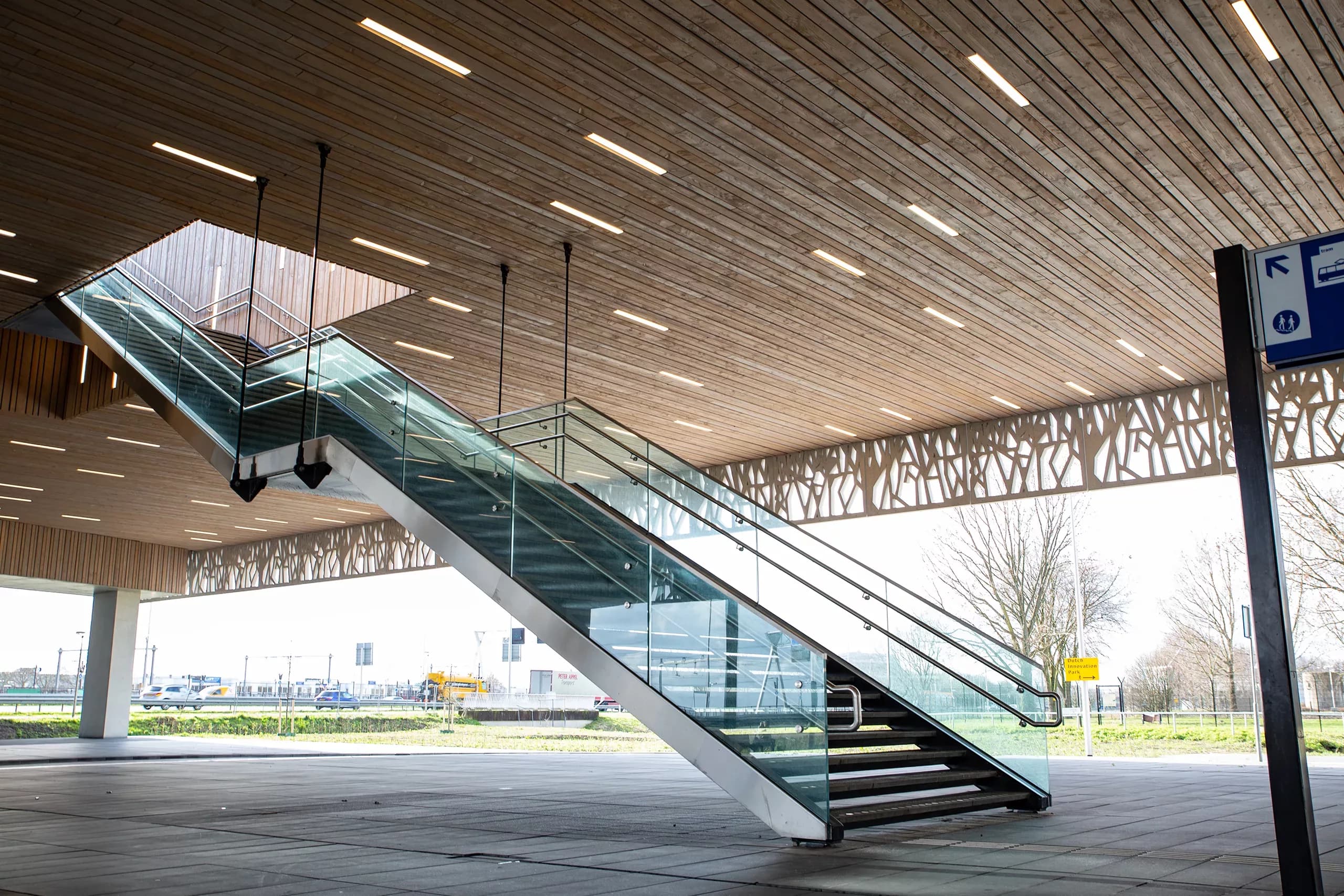
A handrail does two jobs at once. It gives the grip — continuous, graspable, unbroken at landings — and it protects the glass edge, which is the fragile part of a laminated balustrade. On all-glass work it is the handrail that takes the knocks from furniture, suitcases and pushchairs.
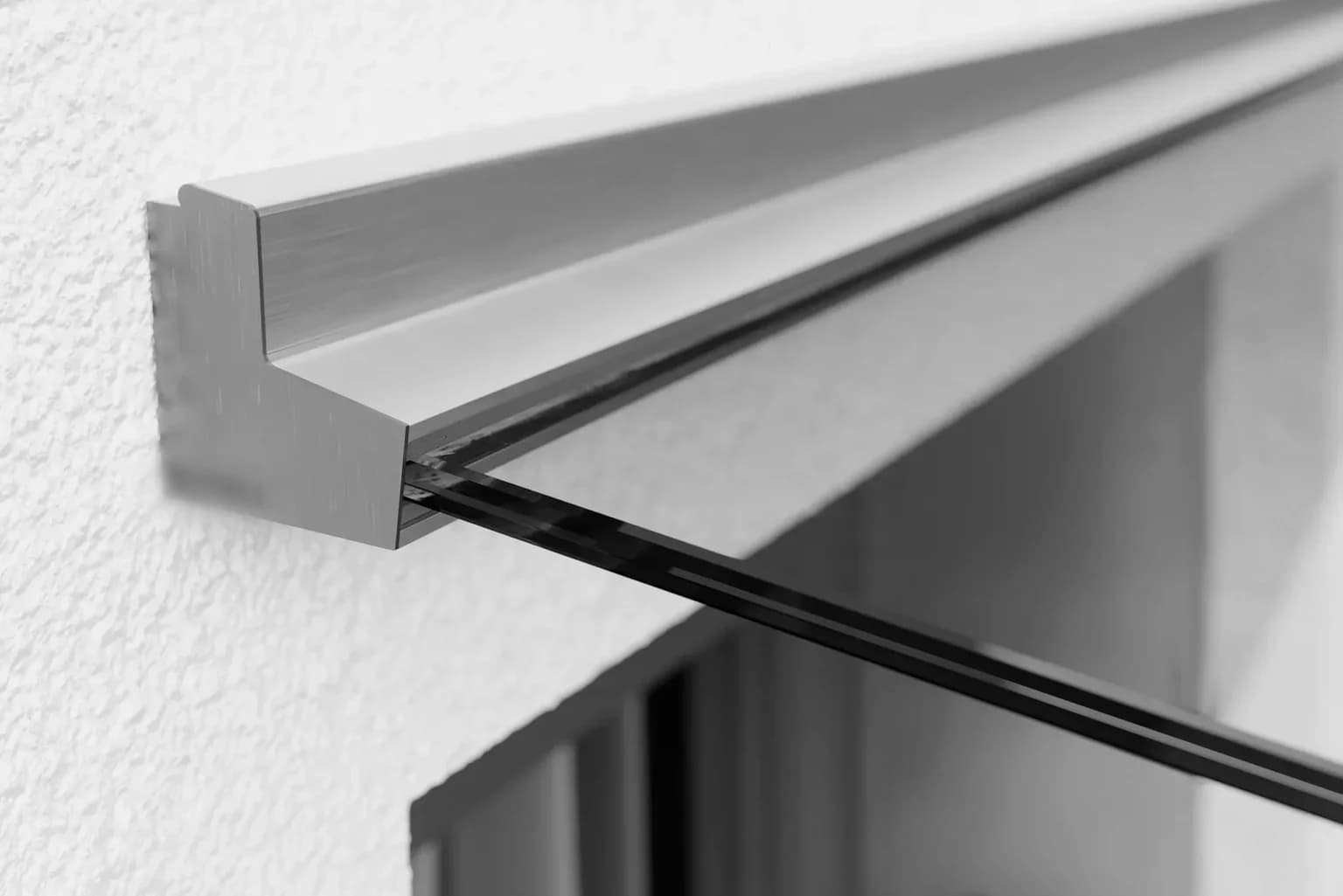
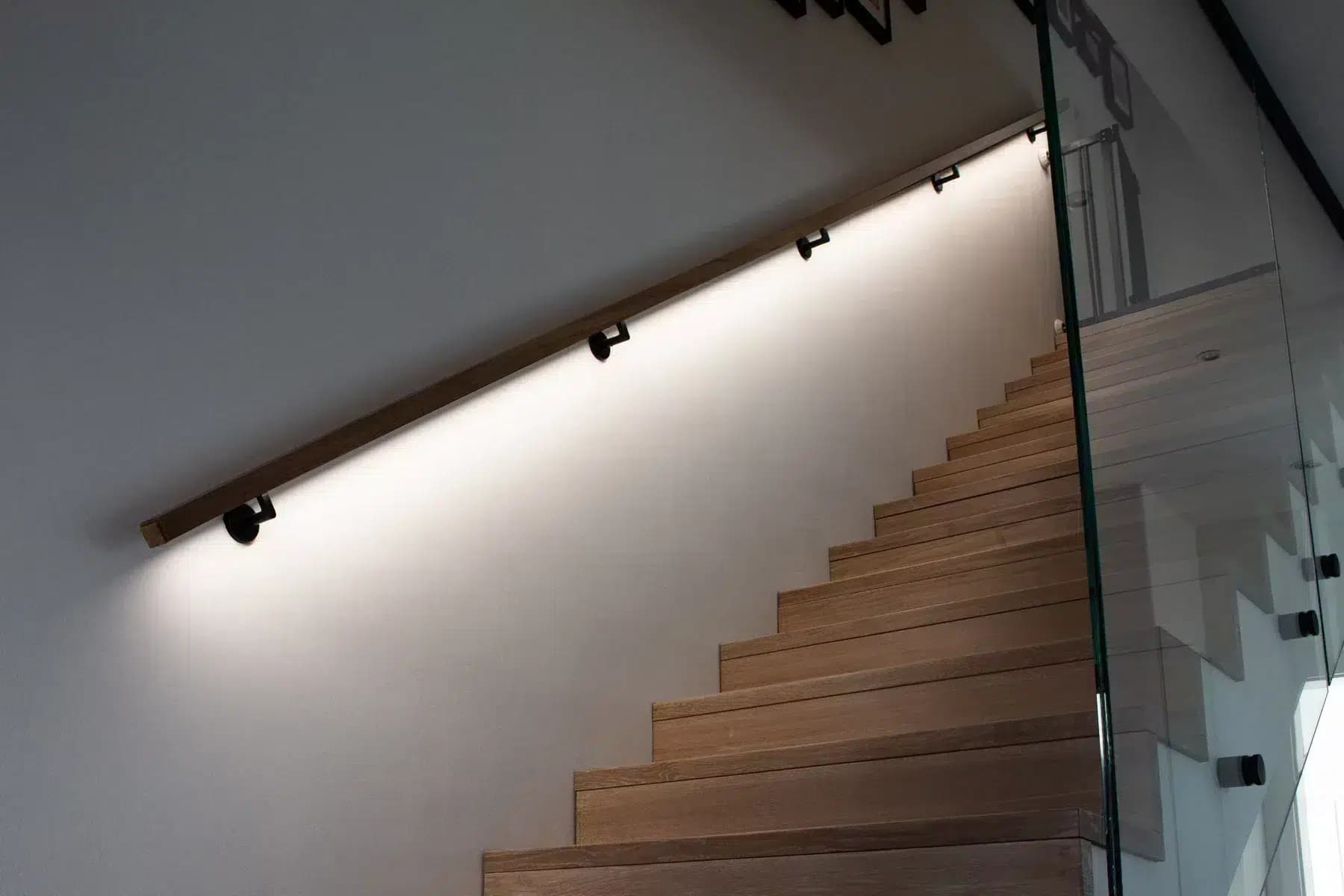
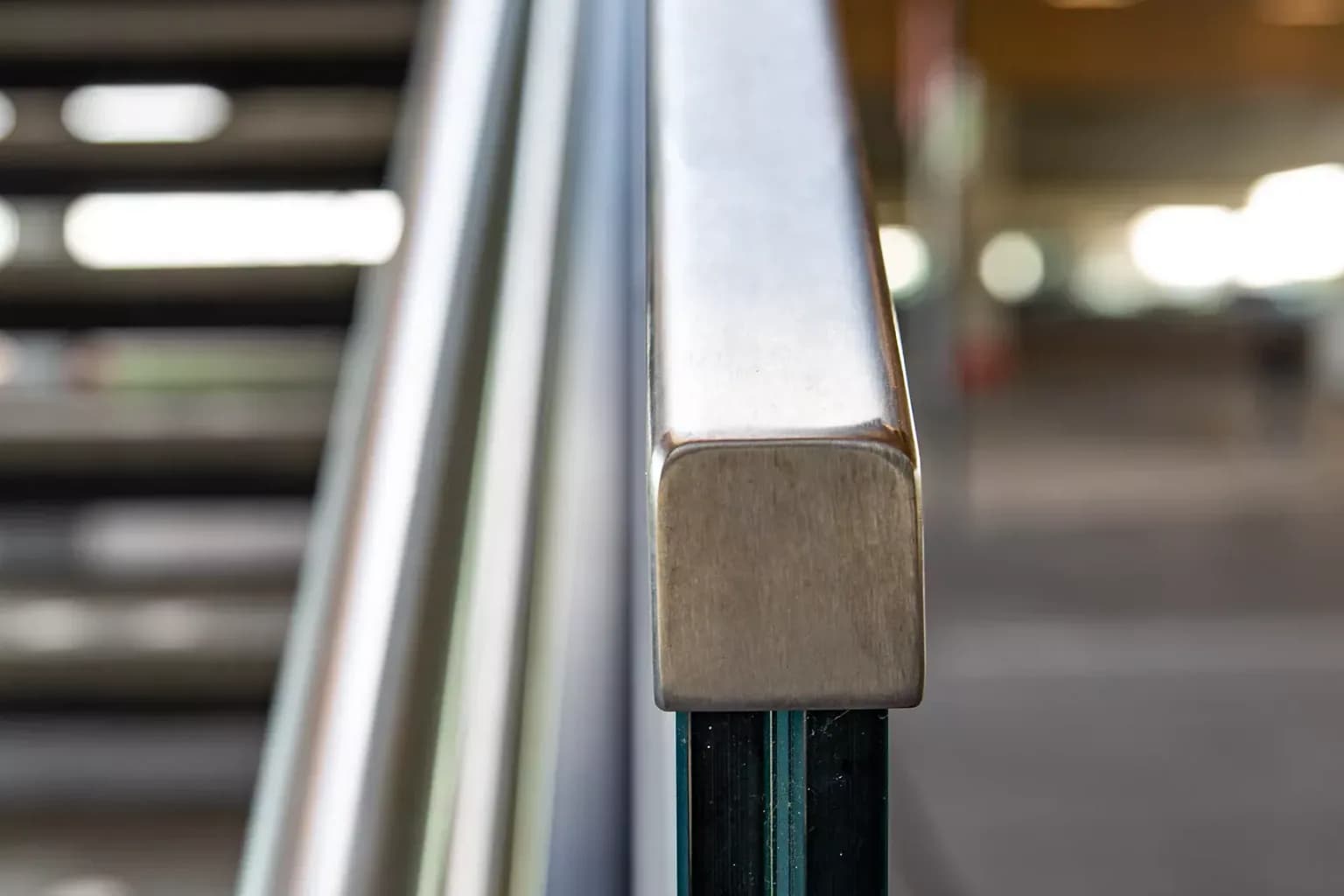
Two families coexist. The round stainless tube, Ø 42.4 or 48.3 mm, is wall-mounted on brackets or glass-mounted on supports: it is the staircase handrail par excellence, the one you catch on the way down. The U-channel cap, in aluminium or stainless steel, caps the glass edge along its whole length — it is less good in the hand, but it gives the cleanest line and it closes the laminate.
The material is chosen on exposure, not on taste. Indoors, galvanised steel is enough for the fixings. Outdoors you move to 304 stainless, and to 316 as soon as there is de-icing salt, pool chlorine or the damp air of a lake. On Lake Geneva as in the mountains, it is the grade that determines the appearance ten years on.
The installation is what shows. A handrail is judged on its joints: a badly fitted end, a bend out of plane, a support three millimetres off, and the whole job looks improvised. We survey the real heights before ordering — a flight of stairs is never exactly as drawn — and we take up the deviation on the supports, never on the glass.
- Stainless tube Ø 42.4 or 48.3 mm, or U-channel cap in aluminium and stainless steel
- Wall-mounted on brackets, or directly on the glass edge
- 304 stainless indoors, 316 by a lake, at altitude and around pools
- Bendable from a 1 metre radius, bends and ends made to survey
- Aluminium powder-coated in any RAL colour, naturally anodised or stainless-steel look from stock
Compare
Choosing your handrail
Three questions are enough: does it need to be graspable, does it cap a glass panel, and where is it exposed. The lengths quoted are stock bars; cuts, bends and ends are made to survey.
| Model | Application | Glass thickness | Approved load | Fixing centres | Lengths | Mill finish | Anodised | Curvable |
|---|---|---|---|---|---|---|---|---|
| MC-10Stainless tube Ø 42.4 mm, wall-mounted | Private and commercial | Sans objet — pose murale | — | 2 supports par 2,5 m | 2,5 m · 5 m | |||
| MC-20Stainless tube Ø 48.3 mm, long runs | Private, commercial and public | Sans objet — pose murale | — | 2 supports par 2,5 m | 2,5 m · 5 m | |||
| MC-30Aluminium U-channel cap on glass | Private, commercial and public | 12 – 21,52 mm | — | — | 2,5 m · 5 m | |||
| MC-40Stainless U-channel cap on glass | Private, commercial and public | 12 – 21,52 mm | — | — | 2,5 m · 5 m | |||
| MC-50Slimline U-channel cap, thin glass | Private | 10 – 17,52 mm | — | — | 2,5 m · 5 m | |||
| MC-60Timber handrail on aluminium core | Private, internal only | Sans objet — pose murale | — | 2 supports par 2,5 m | 2,5 m · 5 m |
The loads shown are those the system is approved for. Final sizing depends on the use of the space and the wind pressure at the site — that is what we check during the survey.
Downloads
The documents for this range
A4 data sheets, one per profile: vertical section, dimensions, finishes. Final dimensions are set at the site survey.
- MC-10Stainless tube Ø 42.4 mm, wall-mounted
- MC-20Stainless tube Ø 48.3 mm, long runs
- MC-30Aluminium U-channel cap on glass
- MC-40Stainless U-channel cap on glass
- MC-50Slimline U-channel cap, thin glass
- MC-60Timber handrail on aluminium core
Non-contractual documents · Current edition
Downloads
System documentation
Mounting instructions, brochures, technical data sheets and certifications for the systems we install, in their original version.
Catalogue · 1
Brochures · 1
2D drawings · 38
One PDF drawing per article number, served by the manufacturer.
Finish
The finishes
Mill-finish aluminium is not a budget option: it is the base that is then powder-coated in the RAL colour of your choice, including outside the chart. Allow two to three weeks more than stock anodised, and order the ends and bends in the same batch — a part coated six months later never quite lands on the same colour.
Stainless steel is not coated, it is brushed or polished. Brushed, 240 grit, is the most liveable: it does not show fingermarks the way a mirror polish does, and it can be reworked locally if scratched. Mixing coated aluminium and brushed stainless on the same job is a classic — coated balustrade, stainless handrail — and outdoors it is often the best durability-to-price ratio.

- .13
- RAL gloss

- .16
- RAL matt textured

- .18
- RAL matt
- .19
- RAL enhanced, high-durability powder coating

- .AN
- Natural anodised
- .IX
- Stainless-steel look
- .BR
- Brushed stainless, 240 grit
- .PO
- Mirror-polished stainless
The drawing
Drawn before it is installed
Every piece starts from a workshop drawing dimensioned to the half-millimetre. That is what guarantees a true line once on site.
Frequently asked questions
About handrail
01At what height is a handrail fitted?
0.90 m measured vertically from the nosing on a flight, 1.00 m on a landing. A second handrail at 0.75 m is justified as soon as there are children or public use. When it caps a balustrade, the balustrade height governs: 1.00 m up to a 12 m fall height, 1.10 m above.
02Is a handrail needed above the glass?
Not in every case, but we recommend it on a laminated balustrade without posts: it protects the edge and limits the consequences of delamination. On a raking balustrade it becomes indispensable in practice — it is what provides the grip. In public buildings it is nearly always required.
03What glass thickness does a U-channel cap take?
12 to 21.52 mm as standard, 10 to 17.52 mm on the slimline profile. Packing is done with blocks and a gasket, never by force: a cap that grips the glass breaks it at the first expansion. On a south façade, the temperature swing on the glass between a January morning and an August afternoon exceeds 60 °C.
04Can a handrail be curved?
Yes, from a radius of 1 metre, tube as well as U-channel. Bending is done in the workshop on a template surveyed on site: a radius given on the drawing and a radius measured on the cast slab are not the same radius, and the difference cannot be absorbed during installation.
05How are two lengths joined?
By an internal pinned sleeve, or by welding and repolishing on stainless steel for an invisible joint. On coated aluminium the sleeve is preferred: a weld means recoating the whole bar, and therefore matching the colour again.
06Which fixings for which substrate?
Concrete, timber or steel anchors depending on the substrate, in galvanised steel indoors and 304/316 stainless outdoors. On doubtful concrete — refurbishment, lightweight slab, old render — the anchor is validated by a pull-out test. That is settled at survey, not at a desk.
07304 or 316 stainless?
304 indoors and in ordinary atmospheres. 316 as soon as there is chlorine (pool, spa), de-icing salt on a mountain road, or the damp air of a lake. The price difference is a matter of tens of per cent; a 304 that pits by a lake, on the other hand, is replaced entirely.
08Does timber last outdoors?
Reserve it for indoors. Outside it greys, it splits, and it wants a fresh coat every two to three years. On a south-facing balcony at altitude, that is maintenance you regret after two winters.
09What bar lengths?
2.5 m and 5 m as standard. Mill finish intended for coating, 5 m only. Custom lengths are possible above a minimum quantity — case by case, generally on long runs in apartment buildings.
10Does it need maintenance?
Soapy water and a soft cloth, twice a year; three times by a lake or at altitude. On stainless steel, never wire wool or chlorine-based products: the iron particles left on the surface rust and produce pitting spots that get wrongly blamed on the stainless steel.
11What does an installed handrail cost?
The order of magnitude runs from 120 to 400 CHF per linear metre, supplied and installed, depending on material, section, number of bends and accessibility. A staircase with three flights and returns costs more in installation than in material — the survey is what tells you.
12Are the systems certified?
The systems we install are certified, backed by testing. We attach the test reports for the chosen system to the quote.
The systems we install are certified
 SIA 261Loads — Swiss standard
 CEEuropean conformity
 BS 6180Balustrades — building
 AbP LGAApproved German testing
 CCFATFrench technical approval
 KOMOSKG-IKOB certification
 RPF 14VEROTEC test laboratory
Next step
Take the dimensions with you
This category is measured on site. The catalogue carries every dimension in the range — worth keeping to hand on site.
Made to measure — priced after survey
Would you rather we handled it? Request a quote — site survey, supply and installation included.
- Installation
- By our own teams, anywhere in Switzerland
- Glass
- Laminated, toughened, tinted or acid-etched
- Quote lead time
- Priced within 24 hours, installation included